
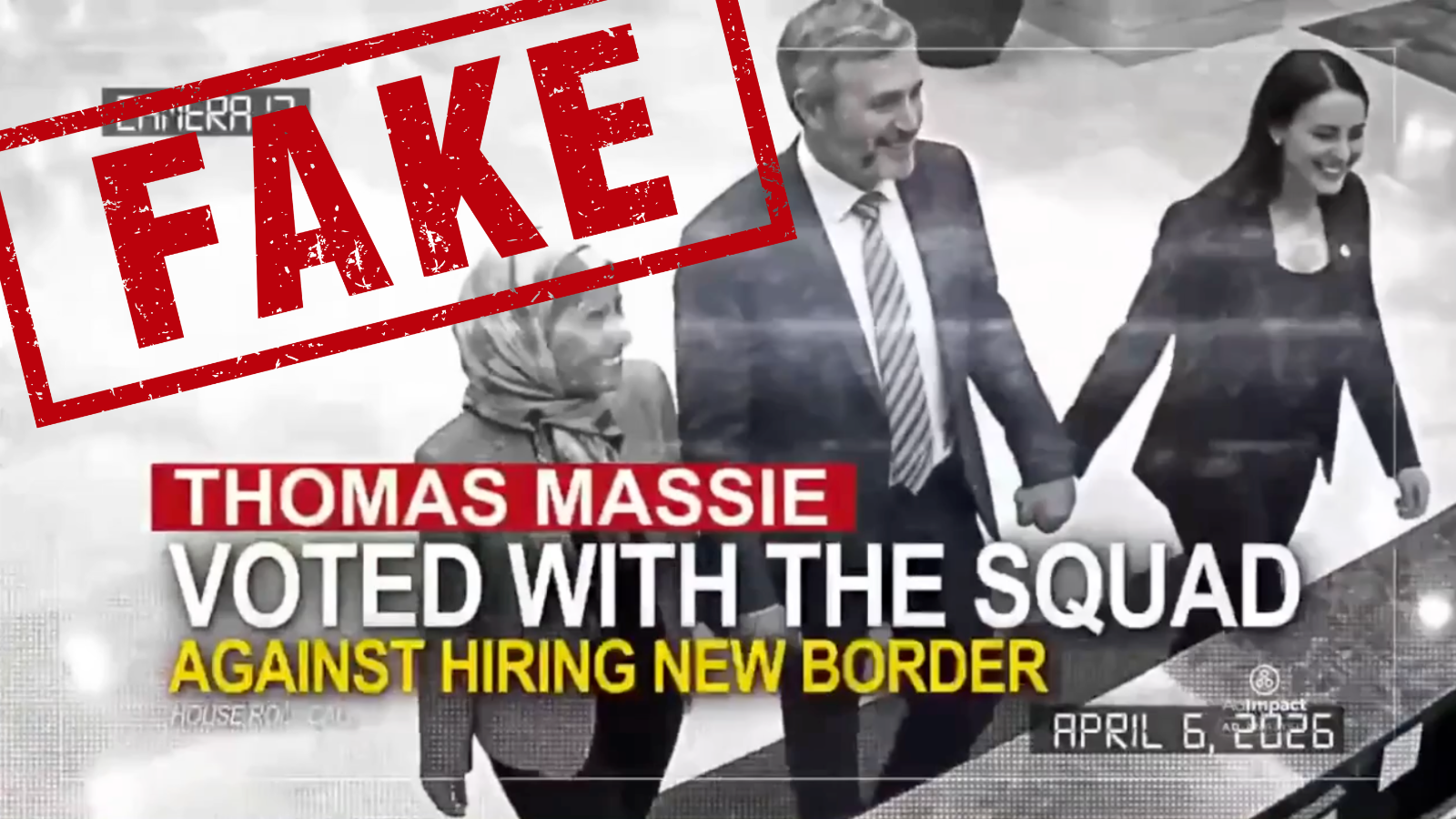
Winner selection: X ignition plus paid-media consequence
This week's winner is not the most beautiful piece of AI filmmaking. It is the ad that best shows how AI commercial production now behaves under real distribution pressure. The clip was circulated on X by AdImpact Politics on May 4, reshared by Massie's campaign account, amplified by Marjorie Taylor Greene, then covered by Mediaite, Kentucky Public Radio/WEKU, Washington Examiner, AP, and others.
The ad was not an isolated meme. It sat inside a record-spending primary and a May 19 result. Washington Examiner reported nearly $33M in advertising and media spending. WEKU reported the MAGA KY PAC had spent $4.5M attacking Massie since last summer, while the pro-Massie Kentucky 4th PAC had spent nearly $2M on its own AI-driven attacks against Ed Gallrein. AP called Gallrein's primary win on May 19. That combination of X spread, paid placement, backlash, fundraising response, and election-night context makes it the highest-confidence ad case this week.
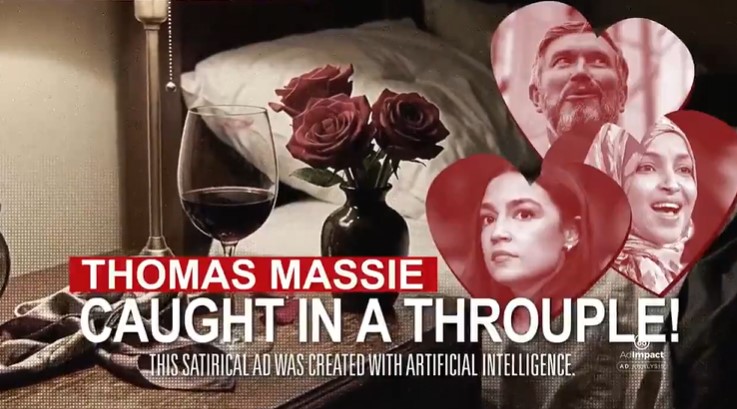
Watch the posts and coverage referenced
- AdImpact Politics X post, May 4, 2026, sharing the MAGA KY AI-generated ad
- Thomas Massie campaign X post, May 4, 2026, condemning and reposting the ad
- WEKU/Kentucky Public Radio explainer with both deepfake ads
- Mediaite coverage of Marjorie Taylor Greene's response
- Washington Examiner spending context, May 19, 2026
- AP election result, May 19, 2026
Creative strategy: make a voting-record argument feel like tabloid footage
The underlying message was ordinary attack-ad logic: accuse an incumbent Republican of siding with Democratic lawmakers and betraying a party leader. The synthetic execution made it travel. Instead of a graphic list of roll-call votes, the ad used fake CCTV, staged dinner imagery, relationship language, and a sensational hook. It translated an abstract ideological claim into a visual scandal frame.
That is why AI ad creation can outperform traditional production in high-velocity political and issue work. Generative tools can literalize metaphors. A strategist can turn "voted with them" into "walked into a hotel with them" and build the whole thing as a fake exposé in hours or days. The engagement upside is obvious. The trust problem is just as obvious.

Hook structure: accusation first, disclosure second
The opening move was blunt: a scandal phrase before the viewer has time to inspect the craft. The ad then used familiar surveillance and tabloid conventions to create false documentary texture. The disclosure existed, according to Mediaite and WEKU, but in small on-screen text. That ordering matters: attention is won by the accusation and imagery; comprehension depends on whether the viewer notices the disclaimer.
For an AI advertising agency, the practical lesson is not "make deceptive ads." It is that hook hierarchy now carries legal, ethical, and performance weight. If the disclosure is visually weaker than the allegation, the creative may earn impressions while creating a brand-safety and regulatory liability. In commercial work, disclosures, satire frames, or synthetic labels have to be designed as part of the hook rather than appended as a legal afterthought.

Visual language: cheap realism beats polished fantasy
The strongest formal choice was not cinematic polish. It was cheap realism: fake security footage, grayscale surveillance, big red "fake" stamps in coverage thumbnails, and tabloid-style sequencing. The ad did not need perfect photorealism. It needed just enough likeness and format familiarity for viewers to stop scrolling and argue about intent.
That is a warning for generative video production. Many teams still judge AI video by whether it looks like a premium film. In performance media, rough documentary cues can be more effective than beautiful cinematic prompts. They lower the craft bar while raising the trust risk. The more an AI video commercial borrows from evidence formats, the more carefully a brand has to manage consent, disclosure, and factual grounding.

Prompt/model stack: unknown tools, clear workflow pattern
Known: public reporting identifies the MAGA KY PAC as the spender behind the anti-Massie ad and notes the ad included an AI disclosure. WEKU reported a second AI-generated anti-Gallrein ad from the pro-Massie Kentucky 4th PAC. The exact production stack has not been publicly disclosed.
Likely workflow: the production pattern is familiar: opposition-research claim, script, synthetic likeness or image generation, video/image-to-video assembly, fake surveillance treatment, voiceover, compliance disclaimer, cutdowns, and fast distribution through paid media and X. AI agents for marketing could accelerate several steps: vote-record extraction, claim substantiation, risk checks, audience-specific cutdowns, and real-time comment theme monitoring. The missing piece is governance. Agents can speed up a bad claim as easily as a good one.
Distribution context: outrage became the media plan
The ad worked because opponents helped explain it. Massie reposted it to condemn it. Greene amplified the legal and moral critique. Local public radio covered the deepfake mechanics. National outlets framed it as proof that AI ads had entered mainstream campaign warfare. Then the May 19 primary result gave the ad cycle a final news peg.
This is the uncomfortable performance lesson: AI controversy can create a second media buy. The paid spot buys initial reach; the backlash creates earned reach; the fact-checking creates explanatory reach; the election result creates retrospective reach. For brand teams, that loop is only useful if the underlying promise is defensible. Otherwise the campaign teaches the audience to remember the tactic and distrust the sender.

Metrics snapshot (captured May 20, 2026)
| Signal | Observed value | Source date | Confidence |
|---|---|---|---|
| Original X ignition | AdImpact Politics shared the anti-Massie AI ad on X; native counters unavailable in logged-out capture | AdImpact X post, May 4, 2026; Washington Examiner embed, May 19 | Medium |
| Massie campaign reaction on X | Mirror snapshot showed about 364K views, 4K likes, 860 reposts, 334 replies, and 125 saves/bookmarks | TwStalker mirror crawled mid-May; WUKY embedded the same post, May 6 | Medium |
| Greene amplification on X | Mirror snapshot showed about 194K views, 8K likes, 2K reposts, 456 replies, and 203 saves/bookmarks | TwStalker mirror crawled mid-May; Mediaite quoted the post, May 5 | Medium |
| Paid-media environment | Nearly $33M in advertising and media spending in the KY-04 primary | Washington Examiner, May 19, 2026 | High |
| AI-ad spender context | MAGA KY PAC: $4.5M attacking Massie since last summer; Kentucky 4th PAC: nearly $2M attacking Gallrein since April | WEKU/Kentucky Public Radio, May 5, 2026 | High |
| Fundraising response | Massie campaign reported $847,950 in under four days and was $47K short of a $1.1M goal by May 8 at 2pm ET | 2paragraphs, May 8, 2026 | Medium-High |
| Outcome context | Ed Gallrein defeated Thomas Massie in the Republican primary | AP, May 19, 2026 | High |
Uncertainty note: authenticated X analytics were not available. X engagement rows use public mirrors and article embeds, so view/repost/comment/save fields should be read as directional rather than first-party analytics. Paid-spend, PAC-spend, and election-result rows are higher-confidence because they come from named public reporting.
Sentiment and feedback read
A small public-reaction read across X mirror snippets, Reddit primary threads, and earned coverage showed three dominant themes. Positive or effectiveness-focused reactions treated the ad as a hard-hitting loyalty attack and proof that low-cost synthetic media can shape paid political communication. Neutral reactions focused on whether the disclaimer was legally sufficient, who funded the PACs, and whether the spot was materially different from old-school caricature ads. Critical reactions called the video deceptive, defamatory, or evidence that AI political media is moving faster than voter literacy.
The most important performance signal is that the ad gave every side something easy to say. Supporters could repeat the betrayal frame. Critics could repeat the deepfake-risk frame. Journalists could explain the disclosure and campaign-finance context. That is why it drove engagement: not because the craft was flawless, but because the creative conflict was instantly legible.
What commercial teams can copy without copying the damage
Do not copy the deception. Copy the operating model with stricter constraints: translate an abstract message into one visual metaphor, build the first three seconds around instant recognition, test the disclosure as part of the creative, and plan the response loop before launch. That is how AI video commercials can use speed and specificity without burning trust.
The best brand-safe version of this workflow is hybrid: human strategy, claim checking, consent-aware image generation, transparent generative video production, structured review, and post-launch measurement. The real advantage of AI commercial production is not that teams can make any image. It is that they can make, test, and revise sharper campaign arguments while the market conversation is still live.
We build practical systems for AI ad creation, storyboarding, AI filmmaking, generative video production, synthetic-media governance, and performance-ready campaign films.
Sources
- AdImpact Politics X post sharing the MAGA KY AI-generated ad, May 4, 2026
- Thomas Massie campaign X post condemning the AI-generated ad, May 4, 2026
- WUKY: Massie blasts AI ad as "disgusting and defamatory", May 6, 2026
- WEKU/Kentucky Public Radio: AI deepfake ads attack Massie and Gallrein, May 5, 2026
- Mediaite: MTG says Massie AI attack ad should be taken down, May 5, 2026
- Washington Examiner: Thomas Massie race sets House primary spending record, May 19, 2026
- 2paragraphs: Massie fundraising response after AI "throuple" ad, May 8, 2026
- AP: Massie loses Kentucky GOP primary to Gallrein, May 19, 2026
- TwStalker public mirror of Marjorie Taylor Greene X profile used for directional counter snapshots, crawled mid-May 2026