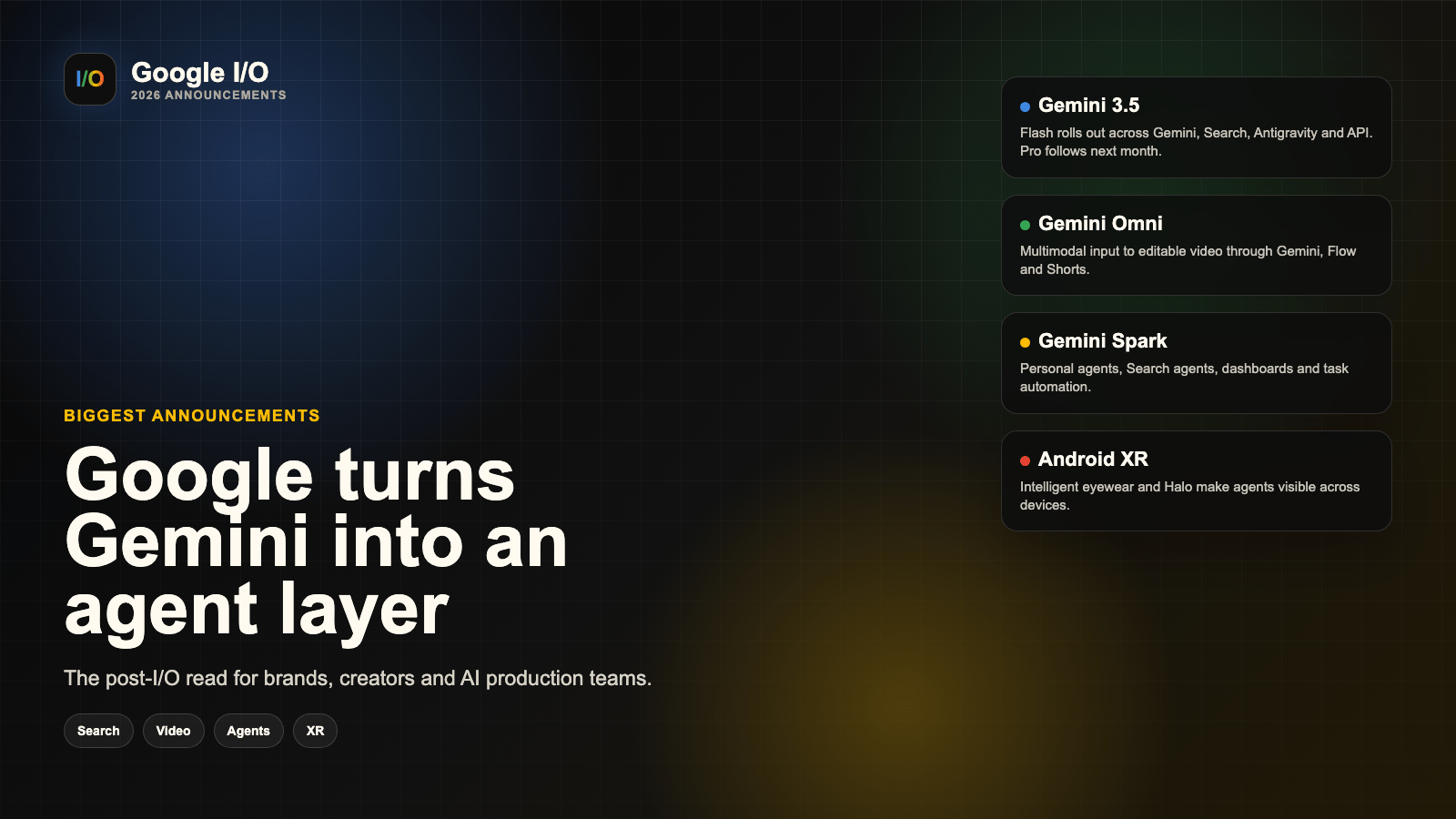
Our preview last week was directionally right: I/O was about proactive AI, Android XR and the move from assistants to agents. The live keynote made the ambition sharper. Google wants Gemini to sit inside the surfaces where people already decide, search, watch, shop, code, message and create.
For AI commercial production, the headline is not one product. It is the stack: stronger models, editable video, personal agents, search agents, wearable interfaces and developer tools that make agents easier to build. The creative opportunity is to design campaigns that can be understood, adapted and acted on by agents, not just consumed by people.
The signal map
| Announcement | Why it matters | Production read |
|---|---|---|
| Gemini 3.5 Flash | Default model push across Gemini app and AI Mode in Search | Faster agentic and coding workflows become mainstream surfaces. |
| Gemini Omni | Multimodal input to editable video | AI video commercials move closer to brief-to-cut iteration. |
| Gemini Spark | Personal agent for multi-step tasks | Brand journeys must account for assistants taking action. |
| Search agents and dashboards | Search becomes a monitoring and task surface | SEO expands into agent-readable offers and live decision support. |
| Android XR intelligent eyewear | Glasses move from demo to product path | Camera-first brand experiences need a practical brief. |
| Antigravity 2.0 and agent tooling | Agents get orchestration, sandboxes and browser/devtool support | Production teams can build safer internal agent workflows. |
1) Gemini 3.5 makes agentic AI a default surface
Google announced Gemini 3.5 Flash as the new rollout focus, positioning it around speed, coding, multimodal strength and agentic tasks. AP reports that Gemini 3.5 Flash is rolling out to billions of users beginning May 19 and that Gemini 3.5 Pro is being used internally with a planned launch next month.
The production implication is simple: agentic behavior is moving into default products. Teams should stop treating agents as isolated experiments and start designing production materials so agents can read them: clear file names, structured claims, source links, approval states, usage rights and canonical product facts.
2) Gemini Omni is the video announcement brands should watch
Gemini Omni was the announcement with the most direct impact on generative video production. It is described as a model family that can take text, image, video and audio input and output editable video grounded in real-world knowledge. Gemini Omni Flash is rolling out through the Gemini app and Google Flow for AI subscribers, with availability in YouTube Shorts and Create.
For AI video commercials, this points toward a practical near future: product images, brand audio, rough clips and written briefs become editable video drafts. The new competitive edge will be less about pressing generate and more about having a clean reference pack, rights-safe assets, channel-specific hooks and fast human review.
3) Spark turns Gemini into an action layer
Gemini Spark is Google's clearest consumer-agent signal. It is framed as a personal agent that can take action under user direction, initially integrating with Gmail, Docs and other Workspace apps, with third-party expansion via MCP expected over the summer. AP notes that Spark is designed to ask for permission before high-stakes tasks such as sending email or making purchases.
That matters for brands because the customer may not be the only actor in the journey. An agent might compare options, watch for price changes, fill forms, summarize terms or decide which brand deserves attention. Campaign pages now need to persuade humans and brief agents.
4) Search becomes a monitoring and decision system
AI Mode is now tied to Gemini 3.5 Flash, and the I/O coverage points to a more conversational, expanding Search box plus background information agents that can monitor the web for changes. Google also previewed custom dashboards and trackers for ongoing tasks.
For SEO and paid media teams, this is a structural change. Search is no longer only a results page. It is becoming a workspace where people ask longer questions, track topics, compare options and hand off parts of the journey to agents. The best campaign pages will be specific, current, structured and easy for AI systems to summarize accurately.
5) Android XR intelligent eyewear makes context visible
Google used I/O to bring intelligent eyewear into the main story. 9to5Google reports first audio glasses coming this fall, built with Samsung and Qualcomm and designed externally with Gentle Monster and Warby Parker. AP photographed Google's Android XR platform lead discussing intelligent eyewear during the keynote.
For creative teams, the useful brief is not "make a glasses ad." It is: what should the brand do when the device can see context? Good use cases will be guidance, comparison, training, live service, retail help, events, accessibility and story moments that make sense because the interface is worn.
6) Antigravity and developer agents show where production tooling is heading
The developer keynote was explicit about the shift from AI assistance to agents that can navigate complex workflows. Google announced Gemini 3.5 models, upgraded Antigravity, introduced Antigravity CLI, discussed specialized subagents, Managed Agents in the Gemini API, Antigravity SDK, Android CLI and skills, Modern Web Guidance and Chrome DevTools for agents.
This is important even for non-engineering teams. Modern production already depends on repositories, websites, landing pages, scripts, asset folders, trackers, docs, automations and deployment workflows. Agentic developer tools make it easier to connect creative operations to systems that can be checked, tested and shipped.
What to do this week
- Update your content architecture: make offers, claims, evidence, FAQs and next actions explicit enough for AI Mode and personal agents to summarize.
- Build a video reference pack: product images, voice rules, audio references, legal exclusions, channel ratios and approval notes for Omni-style workflows.
- Design one agent journey: choose a conversion path where an assistant might compare, monitor, book, buy, request or summarize on behalf of the customer.
- Prototype an XR use case: start with utility, not spectacle. What does the user need help seeing, comparing or doing?
- Harden internal agent workflows: use sandboxes, credential masking, validators, diffs and approval gates before agentic tools touch production systems.
Vertical Haus builds AI commercial production workflows that connect strategy, generative video, source discipline, web publishing, agents and campaign delivery.