
At Vertical Haus, we care about tools only when they change the shape of the work. Codex does. It sits in an unusual place in the stack: close enough to the repo to make real changes, local enough to inspect files and run commands, agentic enough to carry a task from brief to implementation, and connected enough through plugins and skills to reach the systems where production actually lives.
That makes Codex more than a coding assistant. In our pipeline, it is becoming the connective tissue between strategy, website publishing, automation maintenance, AI commercial production, internal documentation, social packaging, and operational follow-through. It is one of the ways we make an AI advertising agency behave less like a loose collection of tools and more like a production system.
This post is not a generic celebration of AI. It is a practical account of how we use Codex now, what the recent updates unlock, and why local agentic workflows matter for a studio building campaigns, AI video commercials, generative video production systems, and AI agents for marketing.
What changed: Codex became an operating surface
OpenAI now describes Codex as a coding agent that helps teams write, review, and ship code, with work happening across the terminal, IDE, app, GitHub, and cloud tasks. The important shift is not simply model quality. It is the product surface. Codex can be used locally through the CLI, inside an IDE, in the Codex app, and in cloud workflows that can be delegated and reviewed.
For a studio, that matters because the boundary between "code" and "production work" is dissolving. A blog post is an HTML file. A social card is an image-generation script. A sitemap is a Node job. A Slack brief is structured text that can become a scope. A Google Sheet can become a production tracker. A Canva deck can become a client narrative. A GitHub workflow can deploy the site. Codex is useful because all of those objects can be inspected, changed, tested, and shipped through repeatable steps.
OpenAI's Codex materials are explicit about this direction: Codex is built for real engineering work, multi-agent workflows, skills, background automations, and high-signal code review. The Codex app adds built-in worktrees so multiple agents can work on the same repository without colliding, while the CLI keeps the agent close to the local machine. That combination is exactly the shape of modern creative operations: many parallel tasks, one shared standard, and a constant need to convert intent into output.
Source: OpenAI Codex product overview →
Source: OpenAI Codex app announcement →
Why local access matters
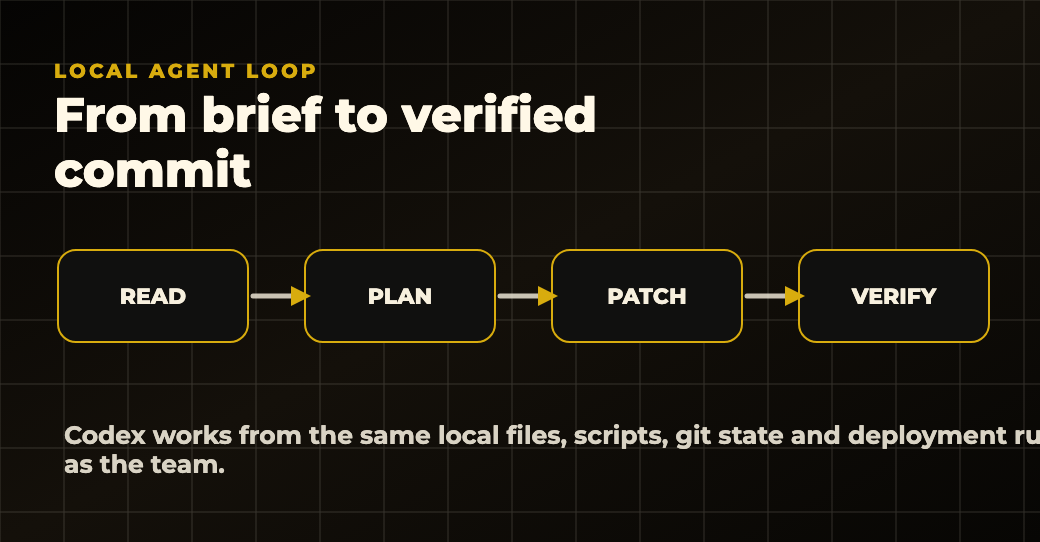
Local access is the difference between an assistant that comments on work and an agent that can do work. Codex CLI can read, change, and run code in the selected directory. In practice, that means it can open the Vertical Haus website repo, inspect the current branch, respect the deployment workflow, edit the right pages, run validation scripts, update sitemaps, and show a clean git diff before anything is committed.
That local context is not a small detail. Most AI tools fail creative teams because they live outside the operational environment. They can draft copy, but they do not know the repo structure. They can suggest a fix, but they cannot run the check. They can write a page, but they do not know whether the image URL is reused, whether the route is indexed, whether Firebase hosting expects files under public/, or whether a previous automation memory file says not to duplicate a work item.
Codex changes the relationship. When it has local access, it can work from the same materials as the team. It can read AGENTS.md, obey repo-specific instructions, use existing templates, detect dirty worktrees, avoid reverting unrelated edits, run shell commands, and update the files that actually ship. For Vertical Haus, that means Codex is not just helping us think. It is helping us keep the website, content system, and production tooling coherent.
Source: OpenAI Codex CLI documentation →
The agent loop, translated for production
The core of Codex is an agent loop: understand the task, inspect context, choose actions, call tools, observe results, adjust the plan, and continue until the work is done. For engineering, that loop produces code changes. For Vertical Haus, the same loop maps cleanly onto production:
- Brief intake: read the request, previous memory, client context, brand rules, and repo state.
- Context gather: inspect relevant pages, templates, prior posts, scripts, and assets before writing.
- Production action: create the post, update the index, validate images, run checks, or adjust the workflow.
- Review loop: compare diffs, verify links, run scripts, and tighten the result against the brief.
- Handoff: report exactly what changed, what passed, what remains risky, and where the user should look next.
That is why Codex is so valuable in a creative pipeline. It does not need the work to be purely technical. It needs the work to be expressible as structured context plus repeatable actions. Our content operation, campaign systems, client decks, production automations, and internal agents increasingly fit that pattern.
Source: OpenAI on the Codex agent loop →
Plugins turn Codex into a production desk
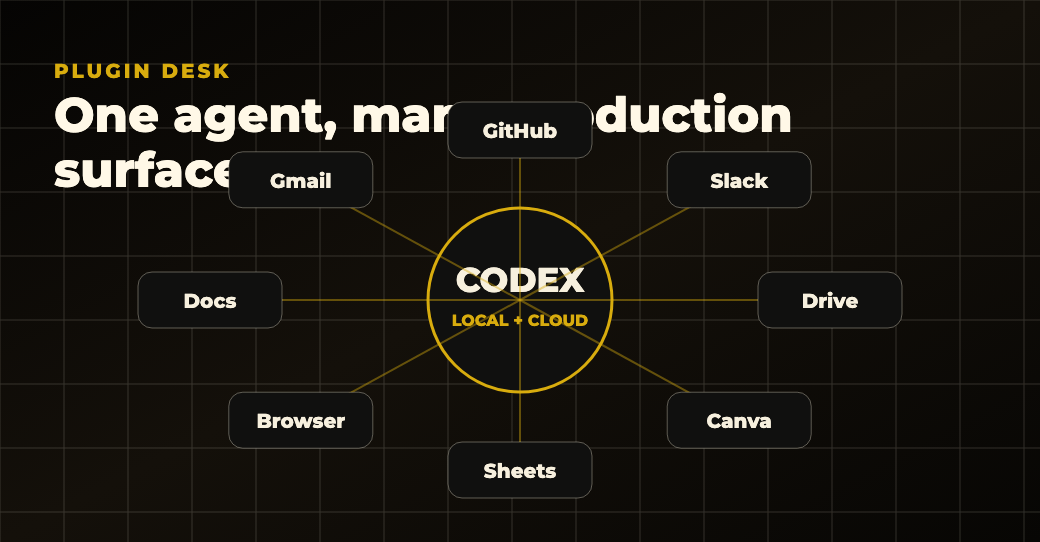
The big unlock is not only local files. It is local files plus plugins. In our Codex environment, plugins and skills connect the agent to the work surfaces where a modern studio actually operates: GitHub, Slack, Gmail, Google Calendar, Google Drive, Canva, Documents, Presentations, Spreadsheets, Hugging Face, browser testing, and image generation.
That means Codex can sit at the center of a production desk. It can inspect a repo, summarize Slack context, draft an outbound update, find a reference document, build or adapt a deck, work with spreadsheets, triage GitHub issues, test a local page in a browser, and package the result into a website change. The agent is not doing every creative decision. It is removing the friction between decisions.
For Vertical Haus, this matters most in the handoff zones. A project usually fails or slows down where one system has to become another: a Slack note becomes a brief, a brief becomes a treatment, a treatment becomes a production plan, a production plan becomes assets, assets become a post, a post becomes a sitemap entry, a sitemap entry becomes a deployment, and the deployment becomes a client-facing proof point. Codex helps keep those conversions clean.
Where we use Codex inside Vertical Haus
1) Website publishing. Codex is now a practical operator for the Vertical Haus site. It can create new blog posts from work-page entries, update the blog index, check image reuse, generate sitemaps, commit, push, and respect Firebase deployment rules. The important part is that it works from the repo's actual conventions instead of inventing a new publishing pattern each time.
2) SEO and editorial systems. We use Codex to enforce repeated editorial standards: stronger source links, better opening narratives, more specific section images, natural SEO placement, and sharper originality. This is how AI commercial production posts become more than diary entries. They become structured search assets for terms like AI filmmaking, AI advertising agency, generative video production, AI ad creation, and AI agents for marketing.
3) Automation memory. Codex can read and update automation memory files. That sounds small until you see the value: recurring tasks stop starting from scratch. If an automation checks the work page every week, it can remember processed identifiers, quality goals, underperformance notes, and next-run upgrades. The system compounds.
4) Pipeline documentation. A production company is full of tacit knowledge: how we quote, how we brief, how we package case studies, how we reference AI tools, how we avoid recycled imagery, how we explain the business outcome. Codex helps turn that tacit knowledge into files, checklists, docs, and templates.
5) Toolchain repair. When a script fails, a sitemap goes stale, a social card generator drifts, or an HTML pattern becomes inconsistent, Codex can inspect the repo and patch the problem. This is not glamorous, but it is the difference between an AI-native pipeline and a folder full of disconnected experiments.
6) Creative operations. Codex is useful for creative work where the output has structure: treatments, decks, prompt systems, storyboard breakdowns, shot logic, production checklists, launch posts, campaign pages, and CRM-facing summaries. The more explicit the format, the more leverage the agent has.
The update that matters: multi-agent work
The Codex app is designed as a command center for agents, with support for multiple agents working in parallel. For us, that points to a more useful operating model than "one assistant in one chat." A campaign can be split into bounded workstreams: one agent checks source context, one drafts the article, one validates technical changes, one prepares the social adaptation, one tests the page, and one reviews the diff.
That is powerful only if the work is scoped correctly. We do not want ten vague agents producing ten vague outputs. We want narrow, accountable agents with clear write scopes, local context, and a standard for verification. Codex makes that kind of parallelism practical because it can work inside branches, worktrees, and local folders where the artifacts are real.
For a studio, this changes the tempo. The bottleneck becomes direction, not typing. The creative lead defines the standard, the agentic pipeline does the repetitive conversion work, and the human team reviews the decisions that matter: taste, strategy, legal risk, brand fit, audience resonance, and final craft.
How Codex supports AI commercial production
Our work increasingly sits between film production, software, and marketing systems. A single AI video commercial might involve a concept document, visual references, prompt chains, model experiments, edit notes, source links, rights checks, social cutdowns, a client deck, a landing page, a blog post, and a deployment. Codex gives us an agentic layer that can move across those materials.
In pre-production, Codex can help transform a loose brief into a structured creative route: audience, problem, proposition, format, deliverables, shot logic, risks, and next questions. During production, it can maintain runbooks and technical checklists for tools, models, file naming, and approvals. After delivery, it can package the work into case studies, blog content, internal notes, and reusable templates.
The deeper point is that AI commercial production is not just about generating frames. It is about generating controlled production systems. Codex helps us build and maintain those systems. It keeps track of the code, the content, the automations, the asset logic, and the operational rules that make the creative work repeatable.
What Codex is not allowed to replace
Our use of Codex is deliberately practical. We do not treat it as taste. We do not treat it as a strategy director. We do not let it make unsupported claims, invent sources, or publish without checks. The value is not that Codex removes the human. The value is that it gives the human a more capable production surface.
That distinction matters for brands. The best use of AI is not automation for its own sake. It is better leverage on the parts of the process that should be systematic: research hygiene, file updates, template consistency, QA, versioning, deployment steps, source tracking, and repeated operational logic. Humans should still own positioning, taste, ethics, final approval, and the difference between "technically finished" and "worth shipping."
Our Codex operating principles
- Read the repo first. Codex should understand the existing system before changing it.
- Prefer existing patterns. The agent should extend the house style, not create a new mini-framework for every task.
- Keep provenance visible. Source links, image origins, scripts run, and verification steps should be easy to inspect.
- Make memory compound. Automations should carry forward quality notes and avoid repeating solved work.
- Use plugins for context, not noise. Connected tools should answer specific production questions or perform specific actions.
- Verify before reporting. If a script, link, deployment, or test matters, Codex should run it or say clearly that it could not.
- Leave a clean handoff. Every run should end with what changed, what passed, and what needs human attention.
The future: an agentic studio stack
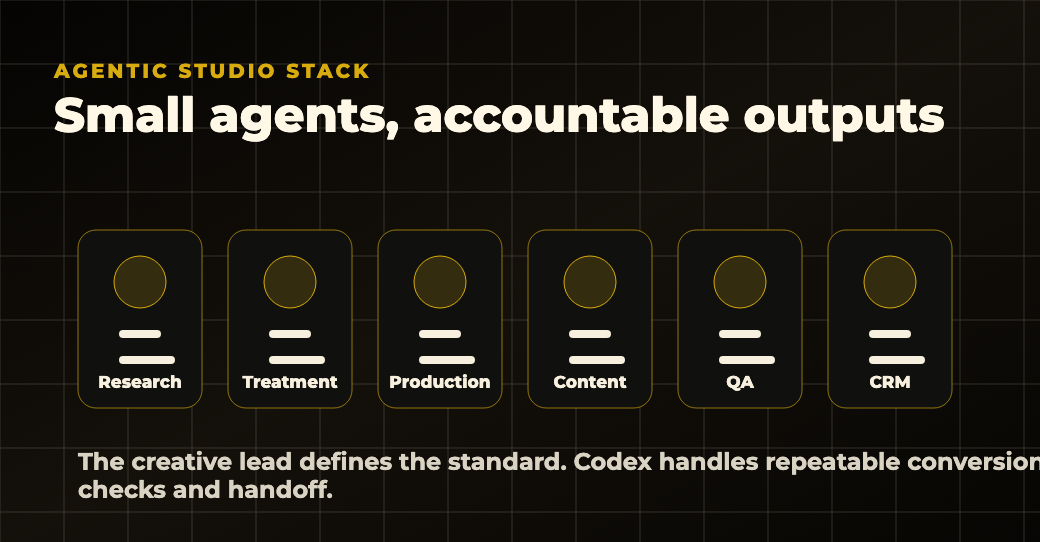
The next step is not one giant agent. It is a studio stack made of smaller, reliable agents. A research agent gathers market context. A treatment agent structures the creative route. A production agent builds the plan. A content agent packages the work. A QA agent checks the site. A CRM agent summarizes the opportunity. A review agent catches the missed edge cases. Codex is the system that can coordinate, inspect, and operate across that stack because so much of modern production is already made of files, commands, APIs, and connected workspaces.
For Vertical Haus, this is how we maximize Codex: we keep it close to the real work. It sits in the repo. It reads the assets. It respects the brand. It uses plugins when context lives elsewhere. It creates artifacts that can ship. It remembers what happened last time. It helps us move faster without accepting vague output as progress.
That is the promise of agentic production. Not less craft. More surface area for craft. More repeatability around the operational parts. More time for the decisions that make a campaign feel authored. And a production pipeline that can keep up with culture without becoming chaotic.
Sources and further reading
- OpenAI: Codex product overview
- OpenAI: Introducing the Codex app
- OpenAI: Introducing upgrades to Codex
- OpenAI: Unrolling the Codex agent loop
- OpenAI Developers: Codex CLI
Vertical Haus builds AI-native creative pipelines for teams that need faster campaigns, better production memory, and sharper AI video output without losing control.