
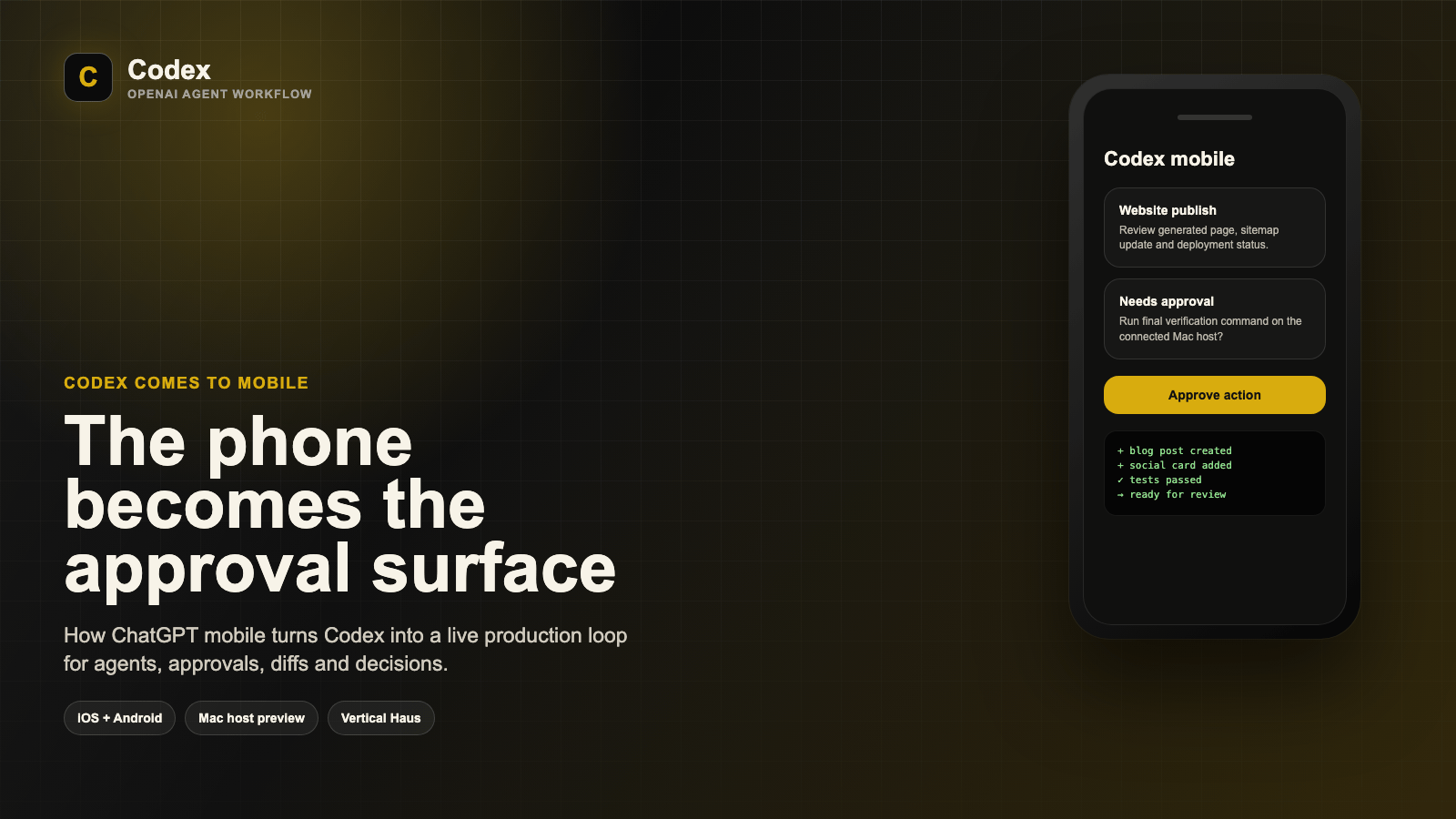
On May 14, 2026, OpenAI announced that Codex is rolling out in preview inside the ChatGPT mobile app on iOS and Android. Codex still does the real work on a connected machine or remote environment. The phone becomes the live control layer: a way to continue threads, answer questions, approve actions, review findings, inspect diffs, and change direction while the agent keeps moving.
For Vertical Haus, that is exactly the shape of modern production. The value is not squeezing a desktop workflow onto a small screen. The value is keeping decisions close to the moment they matter: a deployment approval, a source check, a post title change, a test failure, a design judgment, a client-facing wording call, or a new idea that should become a task before it disappears.
What OpenAI actually announced
| Feature | Status | Production meaning |
|---|---|---|
| Codex in ChatGPT mobile | Preview on iOS and Android | A phone can steer active Codex work instead of only reading the final result. |
| Connected Mac host | Available now | The repo, credentials, plugins, terminal output, screenshots, and diffs stay tied to the machine doing the work. |
| Windows host support | Coming soon | The mobile loop should expand beyond Mac-hosted Codex sessions. |
| Remote SSH | Generally available | Teams can run Codex inside approved remote development environments, then steer from mobile. |
| Hooks | Generally available | Teams can add validators, secret scanning, logging, memory, and repo-specific behavior around Codex work. |
1) Mobile Codex is a steering surface, not a tiny IDE
The weakest interpretation of Codex mobile is "now developers can code from their phone." That misses the point. OpenAI describes a mobile experience that loads live state from the machine where Codex is operating, including project context, approvals, plugins, screenshots, terminal output, diffs, and test results.
That turns the phone into a lightweight control room. You can start an investigation when an issue is fresh, approve a command, choose between two implementation approaches, review what Codex found, or add a follow-up thread without waiting to return to the desk.
2) The key production unlock is reduced idle time
Agentic work often stops for a human decision. Should the agent run a command? Should it choose the conservative fix or the broader refactor? Is this page title too dry? Should the deployment go ahead? Did the screenshot look right? Is the wording client-safe?
Without mobile access, that stop can turn into a dead hour. With Codex mobile, the approval can happen in a queue, in a car, between meetings, or on set. For an AI-native studio, that changes throughput because many production delays are not long tasks. They are short decisions trapped in the wrong place.
3) The phone stays outside the sensitive execution layer
The announcement is careful about where execution happens. Files, credentials, permissions, and local setup stay on the host machine or approved remote environment. The mobile app receives synced context and lets the user steer the work through a secure relay layer.
That matters for real production. A phone is useful for approval and direction, but it should not become a loose copy of every credential, repo, asset folder, or deployment key. The best version of Codex mobile keeps judgment mobile while keeping execution controlled.
4) Hooks make the mobile loop safer for teams
OpenAI also says Hooks are now generally available. Hooks can scan prompts for secrets, run validators, log conversations, create memories, or customize Codex behavior for specific repositories and directories. In practical terms, this is how mobile steering becomes team-safe instead of just convenient.
For a website workflow, a hook can help enforce source hygiene, block unsafe commands, require validation before deployment, or store a memory that the same image should not be reused in a future post. The phone can approve, but the system still needs guardrails.
5) Why this matters beyond engineering
Codex is a coding agent, but the boundary around "code" keeps expanding. A blog post is an HTML file. A social card is an image asset. A sitemap is generated by a script. A campaign landing page is deployed through GitHub Actions. A production brief can become a structured document, checklist, or automation.
For Vertical Haus, Codex mobile makes the agentic production loop more usable. A producer can approve a website update. A creative lead can redirect a draft. A strategist can add a source. A technical operator can review a diff. The work still happens in the repo and connected tools, but the decision no longer has to wait for the laptop to reopen.
Our Codex mobile operating model
- Use mobile for decisions, not deep editing. Approve, redirect, review, and add context; keep complex implementation work on the host.
- Keep every task attached to a real workspace. Codex should work from the repo, host, branch, or remote environment that owns the output.
- Make approval points explicit. Deployments, network calls, file changes, and public-facing content should be visible decision moments.
- Use hooks as production rules. Validators, memories, secret checks, and repo-specific behavior should protect the workflow.
- Review evidence, not vibes. Screenshots, terminal output, test results, diffs, and source links are what make mobile approval credible.
Vertical Haus builds practical AI production systems for teams that need faster creative operations, stronger review loops, and less friction between idea, approval, and shipped asset.