

Why micro dramas are the format to watch
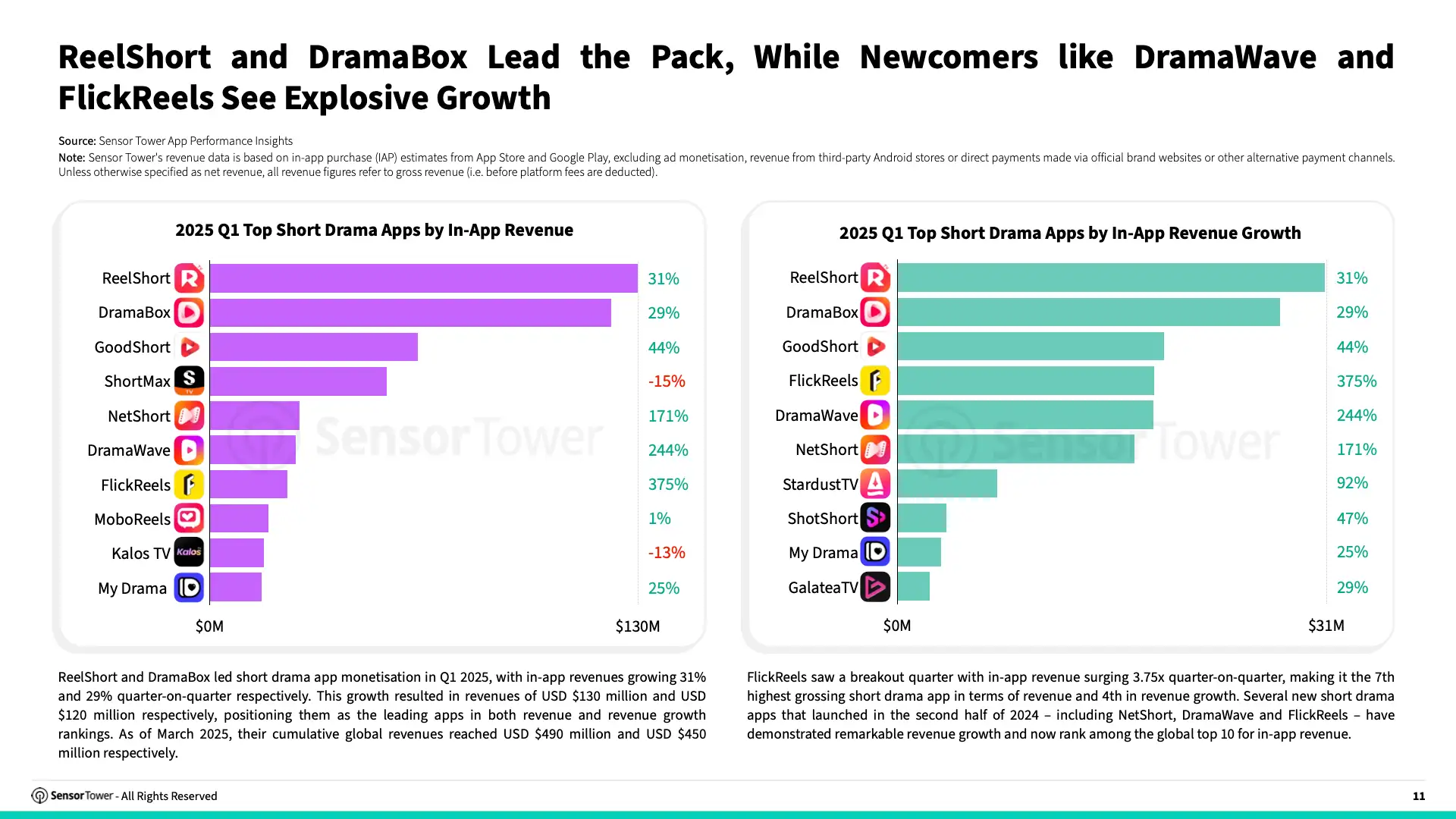
The category is no longer a niche curiosity. Deloitte predicts in-app micro-series revenue will more than double from a forecast $3.8 billion in 2025 to $7.8 billion in 2026. Sensor Tower reported that ReelShort and DramaBox reached $130 million and $120 million respectively in Q1 2025 in-app revenue, with cumulative global in-app revenue of $490 million and $450 million by March 2025.
The growth is not only a China-to-US export story. It is a product shift. Micro dramas combine vertical video, romance/fantasy tropes, aggressive cliffhangers, paid episode unlocks, app-store acquisition and fast creative iteration into one commercial loop. A weak episode is not just bad craft; it is a failed conversion step.
That is why the format matters for production teams. The unit of work is not a 30-second ad or a 45-minute episode. It is a repeatable emotional transaction: open with a problem, reveal status or betrayal, force a choice, hold the answer behind the next tap.

What is popular: romance, status and instant stakes
The visible hits are built around clean emotional machinery: billionaire husbands, forbidden alphas, secret heirs, revenge marriages, pregnancy reveals, medical miracles, criminal families and social reversal. The titles can look extreme because the audience promise must be legible in one glance on a phone.
The New Yorker traces many sticky micro-drama hits back to Chinese web-fiction systems where tropes have already been pressure-tested by audience data. That makes the format feel formulaic, but the formula is part of the product. It lowers comprehension cost, then spends all available time on escalation.
For brands and studios, the useful lesson is not to copy the camp. It is to understand the underlying rhythm:
- Status gap: one character knows, hides or discovers power the audience wants revealed.
- Compressed conflict: every scene starts late and exits on a decision, insult, threat or reveal.
- Paywall-aware cliffhanger: the episode break is written as a conversion moment, not an editorial pause.
- Repeatable world: the genre engine must produce dozens of turns without expensive resets.

AI is entering the production stack, not just the image layer
The strongest AI use cases sit upstream and downstream of the shoot. AI can help generate premise territories, mine trope combinations, stress-test episode beats, build script coverage, translate cultural references, create animatics, plan shot lists, version subtitles, dub voices, repair shots and generate fantasy or impossible inserts. Those are production multipliers when the schedule is measured in weeks.
The proof is moving from theory to release. Vigloo announced Bloodbound Luna, a 22-episode English-language YA supernatural microdrama produced through an AI-native workflow in eight weeks by fewer than 10 creators. The company said the workflow used reference-based AI generation for character movement and fully synthetic voice performances.
That does not mean every micro drama should become fully synthetic. The better question is where AI protects speed without flattening taste. A realistic production model is hybrid: human-led writing, casting and performance where emotion matters; AI-assisted development, visualisation, versioning, localisation and controlled generative inserts where speed and scale matter.
Where AI can be used in a micro-drama pipeline
1. Development and trope mapping. Use AI to map popular trope combinations, generate logline variants, compare episode ladders, identify weak cliffhangers and build character bibles. The output should be judged against retention logic: does episode one create a reason to continue, and does every episode change the emotional debt?
2. AI-assisted scripting. The value is not generic dialogue. It is structural compression. AI can produce alternate cold opens, reveal timing, paywall break options, recap-free exposition and localised idiom passes. A showrunner still needs to decide which version has tension, taste and human specificity.
3. Pre-production and shot planning. Micro dramas need speed, not chaos. AI agents can turn scripts into day-out-of-days, location clusters, prop lists, wardrobe continuity, shot lists and risk notes. This is especially useful when one mansion, hospital, office or bar set must carry an entire world.
4. Generative video support. AI video is most useful for shots that extend scale: establishing frames, fantasy transitions, supernatural effects, phone inserts, dream images, impossible environments and style tests. Fully synthetic scenes can work in fantasy, animation and comic-style formats, but live performance still carries much of the genre's emotional charge.
5. Localisation and dubbing. Micro dramas are global by design. AI-assisted translation, subtitles, voice cloning, dubbing and lip-sync can help a series move faster across English, Spanish, Portuguese, Hindi, Indonesian, Japanese and other markets. The creative risk is cultural literalism: a direct translation can preserve plot while losing status, shame, flirtation or humour.
6. Audience testing and versioning. AI can help generate trailer cuts, ad hooks, thumbnail options, title tests and market-specific descriptions. The format already behaves like performance marketing; production teams should treat packaging as part of the show, not a separate promotional layer.
The production model is changing underneath the format
China's production system shows why AI matters. Xinhua/Qiushi coverage describes vertical production bases with compact sets for banquet halls, mansions, hospitals and subway platforms. One Zhengzhou base has more than 50 sets across just over 10,000 square metres and had served more than 2,600 production teams since trial operation in April 2025. The same report cites local production costs of 300,000 to 800,000 yuan for a 100-episode series, with a three-to-six-month return cycle.
AI presses on that model from both sides. It can make live-action crews more efficient, but it can also reduce the need for some physical production when animated, fantasy or synthetic workflows become good enough. That creates a strategic split:
- Premium live-action micro dramas win on performance, casting, chemistry and local cultural fit.
- AI-native fantasy and animation win on speed, scale, impossible worlds and lower test cost.
- Hybrid production uses human scenes for emotional truth and AI for planning, expansion, localisation and visual support.
The winners will not be the teams that make the most episodes. They will be the teams that learn fastest while keeping the story human enough to convert attention into the next episode.
Why Hollywood and streamers are paying attention
Micro dramas are also becoming a discovery layer for established media companies. Business Insider reported in May 2026 that Peacock is licensing 10 micro dramas from ReelShort for its mobile app, ahead of two Bravo original micro dramas planned for summer. The strategic point is testing: streamers want to understand how people click, stay, navigate and convert inside vertical serial formats.
That matters because the interface changes the story. A TV episode asks for attention upfront. A micro drama earns it every minute. The production workflow has to account for the app, the ad creative, the title, the unlock mechanic and the viewer's thumb as part of the same system.
A practical AI micro-drama workflow
| Stage | AI role | Human control point |
|---|---|---|
| Audience and trope research | Cluster titles, hooks, comments, ads and episode structures by market | Choose the emotional promise and avoid shallow imitation |
| Series bible | Generate character engines, secrets, reveals and episode ladders | Protect motivation, tone and cultural specificity |
| Scripts | Draft alternate hooks, cliffhangers, recap-free exposition and localisation passes | Rewrite for performance, subtext and rhythm |
| Pre-production | Create schedules, set clusters, shot lists, props, wardrobe and continuity checks | Confirm feasibility with director, producer and department leads |
| Production and post | Support animatics, synthetic inserts, VFX, cleanup, subtitles, dubbing and trailer variants | Maintain actor rights, consent, quality and final editorial judgement |
| Distribution | Generate ad hooks, thumbnails, translated metadata and market-specific cuts | Read performance data without overfitting the next story |
What to build next
Build a story engine before building assets. A micro drama needs a repeatable pressure system: desire, obstacle, status, secret, reveal and consequence. AI can accelerate the work, but it cannot rescue a weak engine.
Use AI where it compresses iteration. The biggest gains are in option generation, planning, localisation, trailer testing and synthetic support material. The riskiest gains are in replacing performance before the audience has any reason to care.
Localise the drama, not only the language. The same trope can travel, but status symbols, family pressure, flirtation, shame, money and power read differently by market. AI should flag adaptation questions early, not simply translate late.
Treat every episode break as a product decision. Micro dramas are built around continuation. The cliffhanger is the commercial mechanism. Script, edit, thumbnail, push notification and paid unlock all need to point at the same unresolved question.
Vertical Haus builds AI-assisted production workflows for story development, short-form campaign assets, localisation, testing and cinematic delivery.
Sources
- Deloitte: Short-form video series prediction for 2026
- Sensor Tower: State of Short Drama Apps 2025 Report
- Xinhua/Qiushi: China's micro-drama boom meets AI, April 23, 2026
- BusinessWire: Vigloo debuts fully AI-produced English-language supernatural microdrama, March 10, 2026
- Business Insider: Peacock licensing ReelShort micro dramas, May 13, 2026
- The New Yorker: Inside the world-conquering rise of the micro-drama, May 2026
- ReelShort: current vertical micro-drama platform and title surface