
The useful question is not whether AI can make a clip. It can. The more important question is whether an AI-assisted studio system can move from premise to pilot to market signal quickly enough to improve the next episode, or even justify a full series, before a team has locked itself into a slow and expensive production path.
That is why La Santa Furia matters as a case study. It is not a mood board pretending to be a show. It is a produced episode with a recognisable poster, a TikTok release route, a genre promise, a character world and a measurable audience-testing logic behind it.
Watch the pilot and cutdown
The live TikTok release gives the article its test surface: the full pilot episode, then the shorter retarget cutdown used to push the hook back into-feed.
@verticalhaus
@verticalhaus
Open the pilot episode on TikTok · Open the retarget cutdown on TikTok
Pilot signal table
| Layer | What we tested | Why it matters |
|---|---|---|
| Premise | A masked wrestling drama where faith and fury are in conflict. | A feed audience needs to understand the emotional contradiction instantly. |
| Episode one | The Mask in the Green Room as a contained pilot beat. | The first episode has to sell the world and create continuation intent. |
| Visual system | Poster, character references, costume logic, arena atmosphere and vertical framing. | Consistency matters more than novelty if the show is going to scale. |
| AI canvas | Seedance 2.0 and in-house image canvas workflows for fast look development and scene testing. | The pipeline needs controllable iteration, not isolated prompt luck. |
| Audience signal | TikTok release behaviour, paid test response and retention-oriented diagnostics. | A pilot should tell the team what to make next, not just whether the first cut looks good. |
What we produced
The Calling: La Santa Furia sits in a story territory that makes sense for vertical drama: masked identity, spiritual pressure, public performance, private fear and a highly legible arena world. Wrestling gives the format physical spectacle. Faith gives it stakes beyond winning a fight. The mask gives it a simple visual hook that can survive a small phone screen, a thumbnail and a paid-social cutdown.
That combination is important. A vertical pilot cannot rely on slow world-building. It needs an immediate contradiction: the person the audience sees in public is not the person under pressure in private. The Mask in the Green Room gives that contradiction a place to happen before the arena fully opens up.
The poster was treated as part of the show system, not as an afterthought. For micro dramas, poster, first frame, title, captions and first spoken line all do the same job: they tell the viewer what kind of emotional debt they are about to enter.
Why AI changes the pilot economics
The old route for a short-form scripted idea was slow: develop a deck, commission copy, build a pitch, debate casting, maybe shoot a teaser, then hope the premise survives contact with the audience. The AI-assisted route can move differently. It can create enough controlled evidence to answer practical questions much earlier:
- Does the title carry the right genre promise?
- Does the mask, costume and world read in one frame?
- Can the lead character sustain multiple emotional states without losing identity?
- Does the episode break create enough unresolved tension?
- Which audience angle deserves the next round of spend?
That does not remove production judgement. It moves judgement earlier. Instead of waiting for a finished 40-episode slate to discover that the hook is weak, a studio can test the premise, visual grammar and retention logic while the series is still cheap enough to reshape.
The canvas: character sheets before clips
For an AI micro-drama workflow, the in-house image canvas matters because it makes the production process visual before it becomes expensive. A prompt alone is too loose. A character sheet gives the model and the team constraints: face, silhouette, costume, colour rules, emotional range, camera distance, gesture, world texture and forbidden drift.
In La Santa Furia, that discipline is especially important because the story depends on a masked performer. The mask must stay recognisable. The arena language must feel consistent. The green room cannot look like a random backstage stock scene every time the shot changes. Seedance 2.0 is useful here because the workflow can move from still references into motion tests, then back into sharper prompts and revised visual rules.
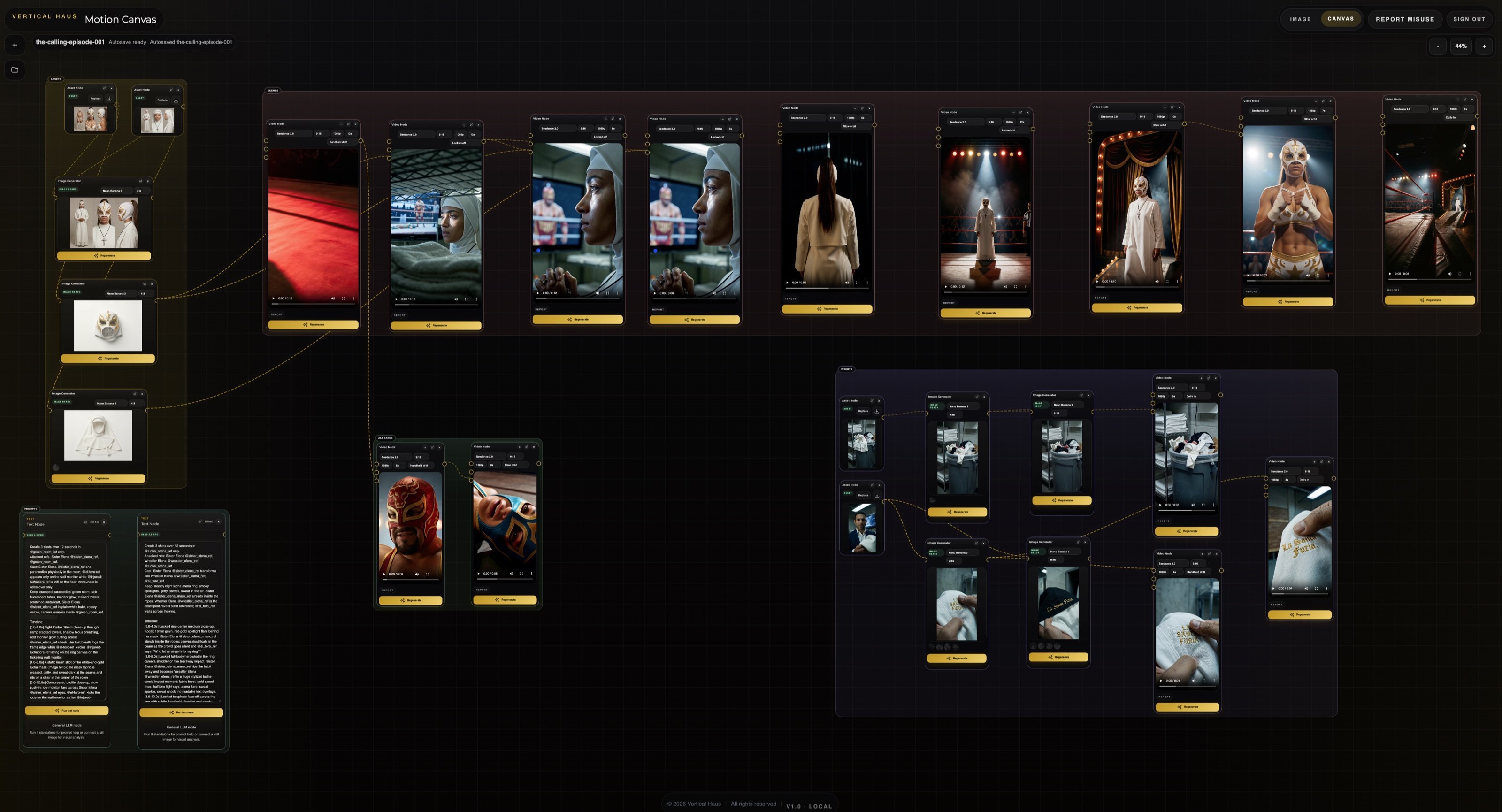
The practical sequence looks like this:
- Define the micro-drama premise and episode-one cliffhanger.
- Build character sheets and world references inside the image canvas.
- Turn those references into shot prompts, poster options and motion tests.
- Cut a pilot or proof sequence that is good enough for audience signal.
- Use TikTok and paid testing to decide what the next episode should emphasise.
This is where AI becomes a studio tool rather than a novelty. The canvas is not just generating pictures. It is compressing look development, continuity checking, trailer exploration and market testing into the same operating loop.
The paid test is not just media buying
A TikTok ad-spend test for a micro-drama pilot should not be judged like a normal awareness campaign. Views alone are not enough. Cheap impressions are not enough. The question is whether the premise creates the behaviours a series needs: stopping, staying, replaying, commenting, following, clicking through and wanting episode two.
For a project like La Santa Furia, the useful scorecard is split into layers:
- Hook clarity: first-frame hold, early watch behaviour and whether viewers understand the masked-wrestling promise.
- Story retention: completion, rewatch, drop-off around dialogue, and whether the cliffhanger holds attention.
- Audience quality: comments, shares, saves, profile actions and requests for the next episode.
- Market fit: which audience pockets respond to faith, combat, secret identity, spectacle or revenge angles.
- Scale readiness: whether the result justifies another episode, another hook test or a fuller series bible.
This is the real commercial shift. AI lets a studio produce more options, but paid testing decides which options deserve more time. The best version of the workflow is not “make more AI video.” It is “make the next version more accurately because the audience has already reacted.”
From one pilot to a full AI-assisted series
A full vertical series does not come from stretching a good clip. It comes from turning the pilot into a repeatable story machine. For The Calling, that means defining the arena hierarchy, the spiritual conflict, the masked identity rules, the rivals, the betrayals, the reveal ladder and the episode breaks that keep the viewer moving.
The AI-assisted series route should look more like a production operating system:
- Series bible: premise, world rules, character arcs, tonal guardrails and episode ladder.
- Character sheets: approved visual identity and performance cues for each recurring figure.
- Prompt library: reusable shot grammars for entrances, green-room tension, ring spectacle, confession beats and cliffhangers.
- Asset matrix: posters, thumbnails, title variants, subtitles, paid hooks and localisation cuts.
- Testing loop: TikTok cuts, paid variants, retention diagnostics and a production decision after each batch.
That is how an AI pilot becomes more than a proof of technology. It becomes a lower-risk way to decide whether a story world deserves the next block of production.
What this means for producers and brands
For producers, the lesson is that a micro-drama pilot can be a market instrument as much as a creative sample. You can use AI to create the first pass, but the value comes from the evidence it creates: which emotion sells, which image stops the scroll, which character creates affinity, and which cliffhanger earns continuation.
For brands, the lesson is similar. A vertical series should not start with product placement. It should start with a story engine that can carry attention. If the product, venue, service or campaign world can become part of that engine, AI-assisted production makes it possible to test multiple routes before locking the campaign.
For platforms, the lesson is retention. A polished pilot is only useful if it gives the next action: another episode, another character test, another market, another paid hook or a reason to stop.
Vertical Haus builds AI-assisted pilots, character systems, prompt workflows, TikTok test assets and audience-led production routes for vertical series and short-drama app content.
Project and workflow references
- Watch The Calling: La Santa Furia pilot episode on TikTok
- Watch The Calling: La Santa Furia retarget cutdown on TikTok
- Vertical Haus Micro Drama Studio credit page
- Vertical Haus x ByteDance: Seedance 2.0 and Seedream 5.0 Lite access
- Seedance 2.5 and production control context
- How to make a ReelShort-style micro drama
- Micro Drama Trends: paid acquisition, AI production and retention context
Method note: this article uses public site material, the local pilot asset set and internal production workflow principles. It treats paid TikTok testing as directional audience signal unless platform-exported completion, spend, click and retention data are published separately.